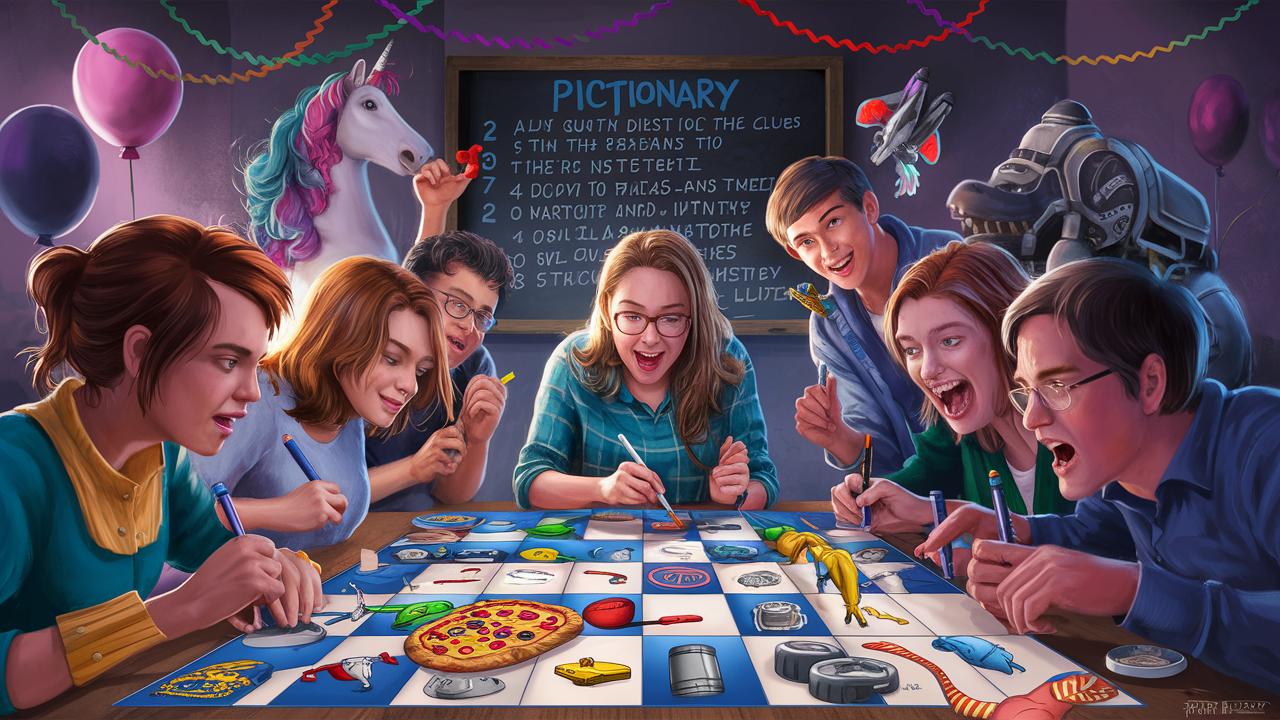
Pictionary Rules and Strategies Drawing to Victory can transform your next game night from ordinary to extraordinary. This classic drawing and guessing game has entertained families and friends for decades, combining creativity with quick thinking in a race against the clock.
Whether you’re hosting your first Pictionary night or looking to sharpen your competitive edge, understanding the rules and mastering key strategies will help you dominate the drawing pad. The game rewards both artistic skill and clever communication techniques that go far beyond simply being good at drawing.
TL;DR
- Standard Pictionary uses 5 categories with 1-minute time limits per turn and teams of 2-8 players each.
- Focus on drawing simple shapes and stick figures rather than detailed artwork – speed beats perfection every time.
- Use the “sounds like” strategy by drawing an ear and then sketching words that rhyme with your target word.
- Master common symbols like lightbulbs for ideas, question marks for confusion, and arrows to show action or direction.
Pictionary Rules and Strategies Drawing to Victory
The basic setup divides players into two teams with each team taking turns having one member draw while teammates guess. The drawer selects a card from five categories: Person/Place/Animal, Object, Action, Difficult, or All Play.
Each round lasts exactly one minute, during which the drawer cannot speak, write letters, numbers, or use gestures beyond pointing at their drawing. Teams advance along the game board by correctly guessing within the time limit, with the first team to reach the finish line claiming victory.
Essential Drawing Strategies That Win Games
Speed always beats artistic quality in Pictionary. Your teammates need recognizable shapes they can identify quickly rather than masterpiece artwork that takes too long to complete.
Start with the most obvious visual elements of your word and work outward. If drawing “elephant,” begin with the distinctive trunk and large body shape before adding details like ears or legs.
The Power of Simple Symbols
Develop a consistent symbol system your team recognizes instantly. Draw a lightbulb for any idea-related words, use arrows to indicate movement or direction, and sketch question marks when your word relates to confusion or uncertainty.
Practice common category indicators like drawing a person’s outline for the Person category or a simple house shape for Place words. These visual shortcuts help your team understand the word type immediately.
Break Complex Words Into Parts
Compound words become manageable when you divide them into recognizable chunks. For “butterfly,” draw a stick of butter first, then add a simple fly, allowing your team to combine the concepts.
Abstract concepts work similarly – break “homework” into a house (home) plus mathematical equations or books (work) to guide your teammates toward the solution.
Advanced Guessing Techniques
Effective guessing requires active participation from all teammates. Call out everything you see in the drawing, even if it seems obvious or wrong – sometimes obvious guesses trigger the right association.
Pay attention to your drawer’s reactions and body language. When they nod vigorously or point enthusiastically at part of their drawing, you’re heading in the right direction with your guesses.
- Category clues – Remember which category the word came from to narrow your guessing focus.
- Rhyming words – If the drawer uses the “sounds like” ear symbol, think of words that rhyme with what they’re drawing.
- Multiple meanings – Consider different definitions of words your teammates are drawing.
- Common phrases – Many Pictionary words are parts of familiar sayings or expressions.
Team Communication Secret
Establish hand signals before playing – point to your ear for “sounds like,” hold up fingers for syllable count, or tap your nose when teammates guess correctly. These non-verbal cues speed up the guessing process significantly.
Mastering Different Word Categories
Each Pictionary category requires specific approaches for maximum success. Understanding these differences helps both drawers and guessers adapt their strategies accordingly.
Person/Place/Animal Category
Focus on distinctive features that immediately identify your subject. For animals, draw their most recognizable characteristic first – a giraffe’s long neck, a elephant’s trunk, or a peacock’s tail feathers.
Famous people work best when you draw their most iconic feature or something they’re known for rather than attempting a realistic portrait. Think Abraham Lincoln’s top hat or Einstein’s wild hair.
Object Category
Objects benefit from showing their function rather than just their appearance. Draw someone using a hammer instead of just the tool itself, or show steam rising from a coffee cup rather than drawing an empty mug.
Consider the object’s environment – a stethoscope makes more sense when you add a simple doctor figure or hospital setting around it.
Action Words
Action words require movement indicators to distinguish them from static objects. Use arrows, motion lines, or multiple drawings showing progression to convey the action clearly.
Draw stick figures performing the action rather than trying to illustrate the concept abstractly. “Running” becomes obvious when you show a simple figure with motion lines and bent legs.
Time Management During Rounds
The one-minute time limit creates pressure that can derail even experienced players. Plan your drawing approach in the first few seconds after seeing your word rather than starting immediately.
Spend the first 10-15 seconds on your main drawing elements, then use the remaining time for details or alternative approaches if your team isn’t guessing correctly. Don’t waste time perfecting one drawing if it’s not working.
- Quick assessment. Look at your word and identify 2-3 ways you could draw it.
- Start simple. Begin with the most obvious visual representation.
- Monitor progress. Watch your team’s reactions to gauge if you’re on the right track.
- Switch tactics. If the first approach isn’t working after 30 seconds, try a different angle.
- Use final seconds. Add arrows, symbols, or clarifying details in the last 15 seconds.
Building Your Team’s Pictionary Skills
Regular practice sessions help teams develop shared understanding and shorthand communication. Spend time before games discussing common symbols and drawing techniques everyone will recognize.
Create a team “dictionary” of agreed-upon symbols for frequently occurring concepts. This preparation pays off during competitive games when split-second recognition makes the difference between winning and losing.
Practice with Difficult Categories
The “Difficult” category cards challenge even experienced players with abstract concepts and complex ideas. These words often require creative interpretation and multiple drawing approaches.
For abstract concepts like “freedom” or “justice,” think about concrete symbols or situations that represent the idea. A bird flying out of a cage suggests freedom, while scales or a judge’s gavel indicates justice.
Frequently Asked Questions
How many players do you need for Pictionary?
Pictionary works best with 4-16 players divided into two equal teams. You can play with as few as 4 people (2 per team) or scale up to larger groups for party settings.
Can you write letters or numbers while drawing?
No, players cannot write any letters, numbers, or symbols that represent letters or numbers. You also cannot use verbal clues, gestures, or point to objects in the room.
What happens if nobody guesses the word?
If the time runs out without a correct guess, the turn ends and no one moves forward on the board. The drawing team passes the dice to the opposing team for their turn.
Are there official Pictionary drawing rules?
Yes, official Pictionary rules prohibit drawing letters, numbers, speaking, using gestures beyond pointing at your drawing, or drawing “sounds like” symbols without first drawing an ear to indicate the strategy.
Final Thoughts
Pictionary Rules and Strategies Drawing to Victory become second nature with practice and the right approach. The game rewards teams that communicate well, think creatively, and stay calm under pressure rather than just those with artistic talent.
Start implementing these strategies at your next family game night and watch your team’s performance improve dramatically. Remember that drawing and guessing games like this create the most memorable moments when everyone focuses on fun rather than perfect technique.
class=”aligncenter size-large wp-image-1699″ title=”Pictionary All Play square and Wild square”

As the founder of Friends Game Night, Ryan channels his enthusiasm for gaming into a platform that celebrates the magic of gathering friends around the digital or physical tabletop. Through his website, Ryan shares insightful articles, reviews, and recommendations, aiming to inspire others to create their own memorable gaming moments.
Subscribe to Our Newsletter