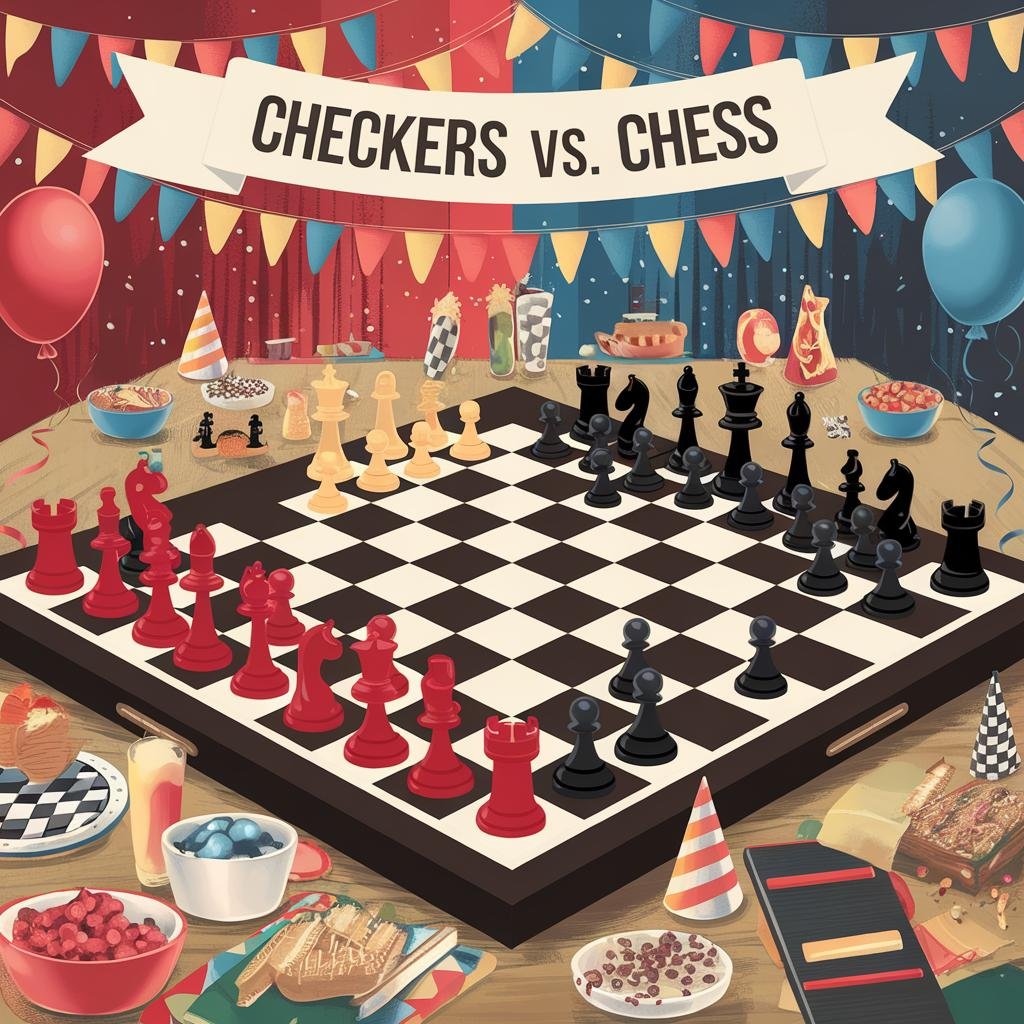
Checkers Vs Chess represents one of the most enduring debates in board gaming history. Both games have captivated players for centuries, offering distinct strategic challenges that appeal to different types of minds.
While chess demands complex tactical thinking across multiple piece types, checkers rewards pattern recognition and forward planning with simpler rules. Understanding the key differences helps you choose which classic game suits your style and skill level best.
TL;DR
- Chess uses 6 different piece types with unique movement patterns, while checkers uses identical pieces that only move diagonally.
- A typical chess game lasts 30-60 minutes, compared to 10-20 minutes for checkers.
- Checkers has approximately 500 billion possible positions, while chess has over 10^120 possible games.
- Chess requires memorizing opening theory and endgame patterns, while checkers focuses on tactical combinations and king positioning.
Checkers Vs Chess: Game Complexity and Rules
The fundamental difference between these games lies in their complexity levels. Chess features six distinct piece types – pawns, rooks, knights, bishops, queens, and kings – each with unique movement capabilities and strategic purposes.
Checkers simplifies the equation with identical pieces that move diagonally forward until they reach the opposite end and become kings. This streamlined approach makes checkers easier to learn but surprisingly difficult to master at advanced levels.
Movement and Capture Mechanics
Chess pieces move in specific patterns across the entire 64-square board. Knights jump in L-shapes, bishops slide diagonally, and rooks move in straight lines, creating complex tactical interactions.
Checkers pieces advance diagonally one square at a time, capturing opponents by jumping over them. The capture mechanism is mandatory when available, removing strategic choice but adding tactical urgency to every move.
Strategic Depth and Learning Curves
Chess offers virtually unlimited strategic depth through its piece interactions and positional concepts. Players spend years studying opening theory, middle-game tactics, and endgame technique to reach competitive levels.
Checkers provides substantial depth through forcing sequences and tactical combinations. Advanced players calculate long chains of forced captures and develop sophisticated king-and-pawn endgames that rival chess in complexity.
Time Investment for Mastery
- Beginner Level – Checkers takes 30 minutes to learn basic rules; chess requires 2-3 hours for piece movements and basic strategy.
- Intermediate Play – Checkers players develop strong tactics within months; chess improvement typically takes 1-2 years of regular study.
- Advanced Competition – Both games require decades of dedicated practice to reach master-level play.
Game Duration and Accessibility
Checkers games typically conclude within 10-20 minutes, making them perfect for quick mental exercise or casual play. The faster pace keeps players engaged and allows multiple games in a single session.
Chess games commonly extend 30-90 minutes, demanding sustained concentration and deeper time commitment. This longer format suits players who enjoy prolonged strategic battles and detailed position analysis.
Choose Your Starting Game
Begin with checkers if you want immediate strategic satisfaction with simpler rules. Start with chess if you prefer complex piece interactions and don’t mind a steeper learning curve.
Social and Competitive Aspects
Both games offer rich competitive scenes, but chess dominates international tournament play and online platforms. Major chess websites like Chess.com host millions of players daily, while checkers maintains smaller but dedicated communities.
Chess provides extensive educational resources, coaching materials, and analysis tools that make improvement more accessible. Checkers resources exist but require more searching to find quality training content.
Historical Significance and Cultural Impact
Chess emerged from ancient Indian Chaturanga around the 6th century, evolving through Persian and Arabic cultures before reaching medieval Europe. Its complex piece hierarchy reflected feudal society and military tactics.
Checkers traces back to ancient Egyptian and Mesopotamian games, developing into modern form during the 12th century. The game’s democratic approach – where all pieces start equal – appealed to broader social classes throughout history.
Modern Digital Presence
Chess thrives in the digital age with streaming platforms, AI analysis engines, and mobile apps reaching global audiences. Professional chess tournaments generate significant viewership and prize pools.
Checkers maintains active online communities but lacks the mainstream digital presence of chess. However, the game’s quicker pace translates well to mobile gaming and casual online play.
Which Game Suits Your Preferences
Choose chess if you enjoy studying complex systems, memorizing patterns, and investing significant time in skill development. The game rewards patience, calculation ability, and strategic planning across multiple phases of play.
Select checkers if you prefer tactical puzzles, quick games, and immediate action without extensive preparation. The game emphasizes pattern recognition, forcing calculations, and adaptability under pressure.
Combining Both Games
Many players enjoy both games for different reasons and occasions. Chess tactics and strategies for beginners can improve your checkers play through enhanced calculation skills.
Playing checkers sharpens tactical vision that transfers to chess middle-game combinations. Both games develop critical thinking skills that complement each other in surprising ways.
Frequently Asked Questions
Which game is harder to master, checkers or chess?
Chess is generally considered harder to master due to its complex piece interactions, extensive opening theory, and multiple game phases. However, both games offer significant depth at the highest levels.
Can playing checkers improve your chess skills?
Yes, checkers improves tactical calculation, pattern recognition, and forcing sequence analysis that directly transfer to chess play. Many chess masters recommend checkers for developing sharp tactical vision.
Which game is better for children to learn first?
Checkers is typically better for children due to simpler rules, shorter games, and immediate tactical rewards. Once comfortable with checkers, children can transition to chess more easily.
Are there professional tournaments for both games?
Yes, both games have world championships and professional circuits. Chess tournaments are more numerous and offer higher prize pools, while the USA Checkers Federation maintains dedicated championship events and strong regional competitions.
Final Thoughts
Checkers Vs Chess ultimately comes down to personal preference and available time commitment. Both games offer rich strategic experiences that have entertained players for centuries.
Try both games to discover which style of strategic thinking resonates with your mind. Many lifelong friendships and family bonding moments have formed around these timeless classics.
class=”aligncenter size-large wp-image-993″ title=”board domination”

As the founder of Friends Game Night, Ryan channels his enthusiasm for gaming into a platform that celebrates the magic of gathering friends around the digital or physical tabletop. Through his website, Ryan shares insightful articles, reviews, and recommendations, aiming to inspire others to create their own memorable gaming moments.
Subscribe to Our Newsletter