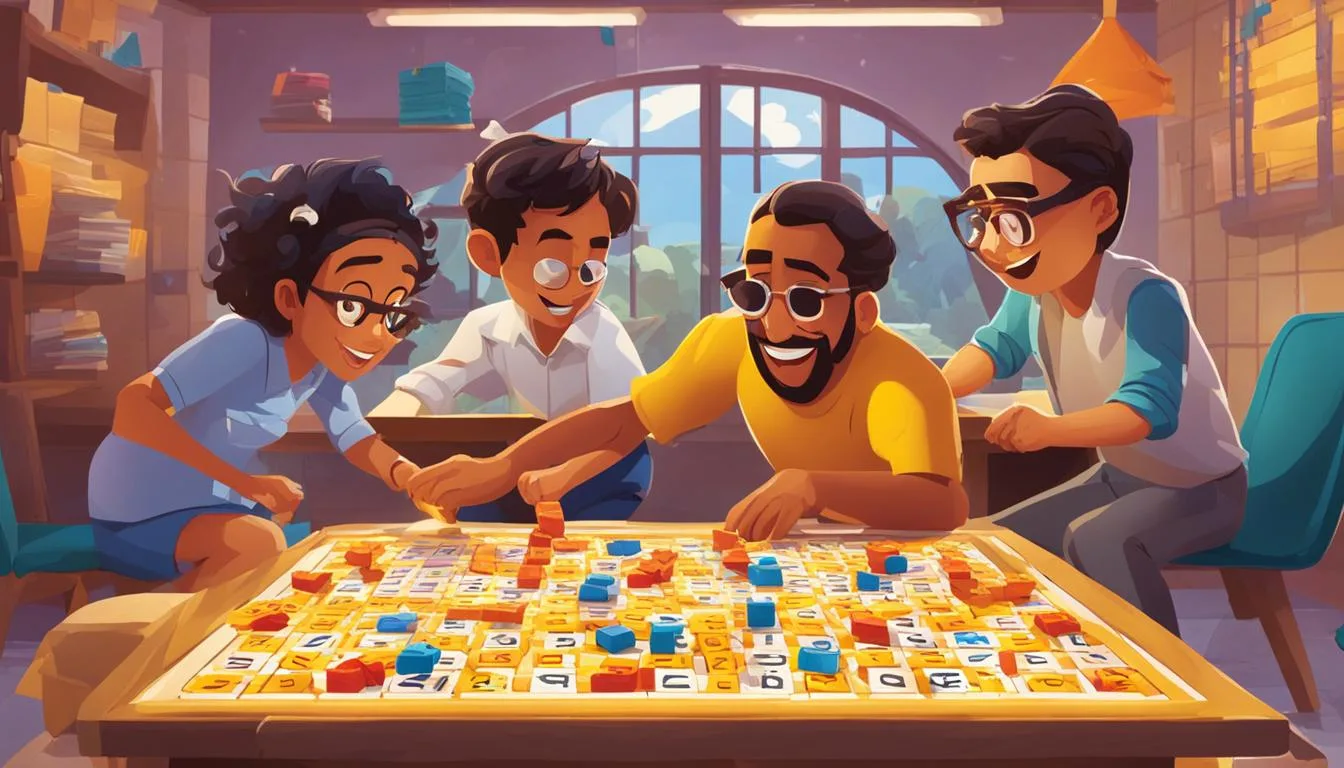
Bananagrams is a fast-paced word game that challenges players to create connected word grids using letter tiles. This portable game combines speed, strategy, and vocabulary skills in a race against time that keeps everyone on their toes.
Players start with a handful of letter tiles and work simultaneously to build their own crossword-style grids. When someone uses all their tiles, everyone draws more from the center pile, creating waves of excitement throughout the game.
TL;DR
- Each player gets 21 tiles to start (with 2-4 players) and builds connected word grids simultaneously.
- Games typically last 15-20 minutes, making it perfect for quick entertainment sessions.
- The banana-shaped pouch contains 144 letter tiles and weighs only 10 ounces for easy travel.
- Players can exchange unwanted tiles by “dumping” one letter and drawing three new ones.
Bananagrams Rules and Setup
Setting up Bananagrams takes less than a minute. Place all 144 tiles face-down in the center of the table – this pile is called “the bunch.”
Each player draws their starting tiles based on the number of players:
- 2-4 players – Each player takes 21 tiles
- 5-6 players – Each player takes 15 tiles
- 7-8 players – Each player takes 11 tiles
Once everyone has their tiles, someone shouts “SPLIT!” and the race begins. Players flip their tiles face-up and start building their individual word grids.
How to Play Bananagrams
The goal is simple: use all your letter tiles to create a connected grid of valid words. All words must connect like a crossword puzzle, and you can rearrange your entire grid at any time.
When you use your last tile, shout “PEEL!” Everyone, including you, must take another tile from the bunch and continue building.
Key Actions During Play
- Build your grid. Create intersecting words using all your tiles – think crossword puzzle style.
- Call “PEEL!” When you use all tiles, everyone draws one more from the bunch.
- Exchange letters. Call “DUMP!” to trade one unwanted tile for three new ones.
- Win the game. When the bunch has fewer tiles than players and someone uses all their letters, they shout “BANANAS!” to win.
The constant peeling creates excitement as players must adapt their grids to accommodate new letters throughout the game.
Bananagrams Strategy Tips
Success in Bananagrams comes from balancing speed with smart letter management. Focus on using difficult letters like Q, X, and Z early in your grid to avoid getting stuck later.
Keep your grid flexible by building in a roughly rectangular shape rather than a long, narrow line. This gives you more options for adding new words when you peel.
Advanced Techniques
- Plan for common endings – Save spaces for -ING, -ED, and -ER combinations
- Use short words strategically – Two and three-letter words like AN, TO, and THE help connect larger sections
- Don’t hesitate to rebuild – Rearranging your entire grid is often faster than trying to squeeze in problem letters
- Monitor other players – Watch for signs they’re about to peel so you can prepare
Master the Dump Strategy
Use the dump option wisely – it’s often worth trading one impossible letter for three manageable ones. The temporary setback usually leads to faster completion.
Popular Bananagrams Variations
The classic game offers several variations to match different preferences and settings. Each variation maintains the core word-building concept while adjusting the pace and rules.
Banana Smoothie
This relaxed version eliminates the peeling mechanism. Players take turns adding one tile at a time to their grids, making it perfect for younger players or casual sessions.
Banana Café
Designed for quiet environments like restaurants, this variation removes peeling but keeps the dump option. It’s ideal when you need to keep noise levels down while still enjoying competitive wordplay.
Banana Solitaire
Challenge yourself with solo play by trying to use all tiles in the shortest time possible. Track your personal records and work to improve your speed and efficiency.
These variations make Bananagrams accessible to different groups and situations, from family board games sessions to quiet coffee shop entertainment.
Educational Benefits
Bananagrams naturally builds vocabulary as players discover new words and letter combinations. The time pressure encourages quick thinking and pattern recognition skills.
The spatial aspect of building connected grids develops visual processing abilities. Players learn to see potential word connections and manipulate their layouts efficiently.
Learning Applications
- Vocabulary expansion – Players encounter new words through trial and error
- Spelling practice – Invalid words must be corrected immediately
- Strategic thinking – Managing letter tiles requires planning and adaptation
- Pattern recognition – Identifying word possibilities becomes faster with practice
Teachers often use Bananagrams in classrooms because it makes learning feel like play while developing essential language skills that support educational standards.
Travel-Friendly Gaming
The compact banana-shaped pouch makes Bananagrams perfect for travel. It fits easily in carry-on bags, backpacks, or glove compartments without taking up precious space.
Unlike many classic board games, Bananagrams requires no board or complex setup. Any flat surface works, from airplane tray tables to picnic tables.
The durable tiles withstand travel conditions, and the zippered pouch prevents pieces from scattering. This makes it an excellent choice for family vacations, camping trips, or long flights.
Frequently Asked Questions
How many players can play Bananagrams?
Bananagrams accommodates 1-8 players, though 2-6 players provides the best experience. Solo play is possible with the solitaire variation.
What happens if someone makes an invalid word?
After someone calls “BANANAS,” other players check their grid for invalid words. If found, that player becomes a “rotten banana” and is eliminated, allowing the next fastest player to win.
Can proper nouns be used in Bananagrams?
No, only common nouns, verbs, adjectives, and other standard dictionary words are allowed. Proper nouns, abbreviations, and foreign words are not permitted according to official dictionary standards.
How long does a typical game last?
Most games finish in 15-20 minutes, making Bananagrams perfect for quick entertainment. Games with more players or difficult letter combinations may take slightly longer.
Is there an official tournament scene for Bananagrams?
Yes, Bananagrams has an active tournament community with regional and national competitions. Many game stores and libraries also host local tournaments.
Final Thoughts
Bananagrams delivers fast-paced word gaming that appeals to competitive players and casual families alike. The simple rules and quick setup make it accessible while the strategic depth keeps experienced players engaged.
Whether you’re looking for game night entertainment or educational fun, this portable word game fits perfectly into any gaming collection.

As the founder of Friends Game Night, Ryan channels his enthusiasm for gaming into a platform that celebrates the magic of gathering friends around the digital or physical tabletop. Through his website, Ryan shares insightful articles, reviews, and recommendations, aiming to inspire others to create their own memorable gaming moments.
Subscribe to Our Newsletter