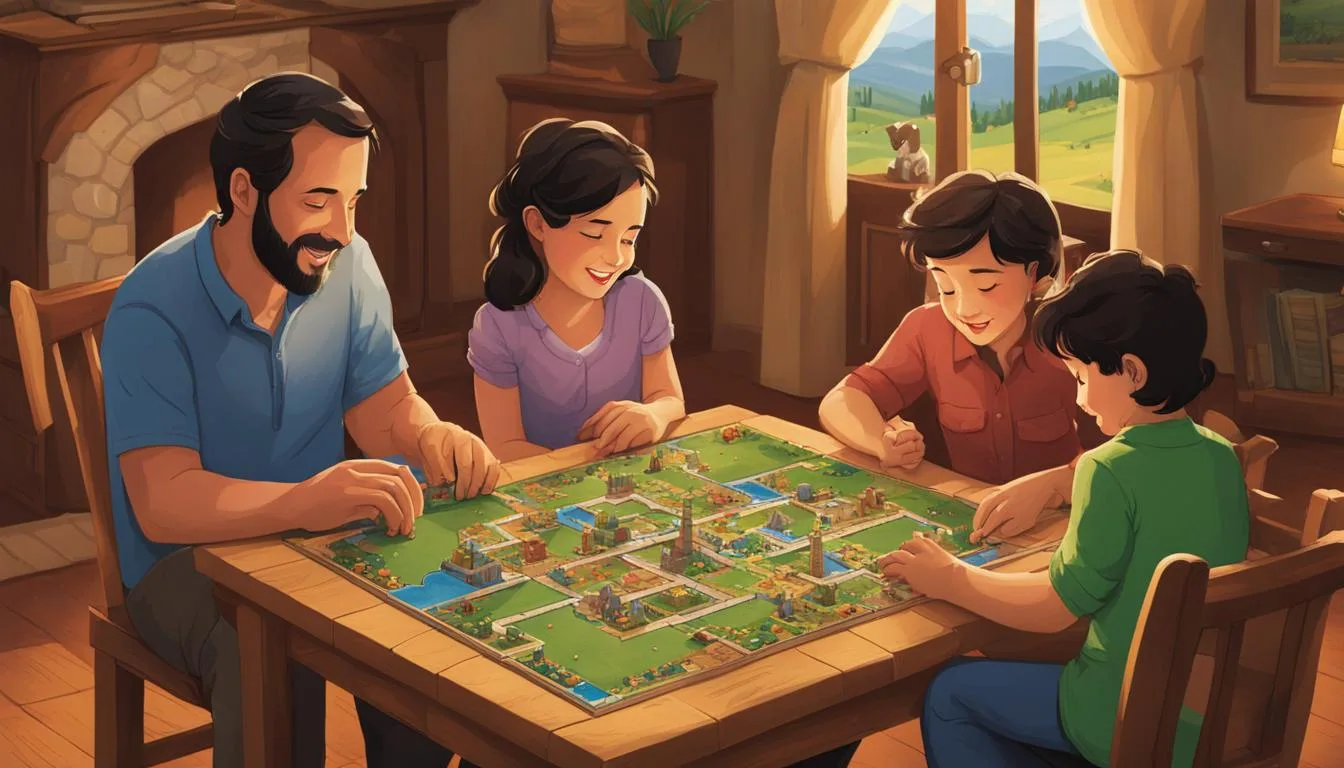
Carcassonne Building A Family Kingdom offers families an engaging tile-laying experience that combines strategy with accessibility. This medieval-themed board game lets players collaboratively build a shared landscape while competing for points through clever placement of followers called “meeples.”
The game strikes a perfect balance between tactical thinking and family-friendly gameplay. Players take turns drawing and placing tiles to create cities, roads, monasteries, and farms across the French countryside, making each game session unique and engaging for all ages.
TL;DR
- Games typically last 30-45 minutes with 2-5 players aged 7 and up.
- Players score points by completing cities (2 points per tile), roads (1 point per tile), and monasteries (9 points when surrounded).
- The base game includes 72 landscape tiles and 40 wooden meeples in 5 different colors.
- Farm scoring at game end can contribute 3 points per completed city the farm touches.
Carcassonne Building A Family Kingdom
This award-winning game transforms your dining room table into medieval France through simple yet engaging mechanics. Each player receives eight meeples and takes turns drawing tiles from a face-down stack, placing them to expand the growing map.
The beauty of Carcassonne lies in its dual nature – you’re building something together while competing individually. Every tile placement affects all players, creating natural interaction and discussion around the table.
Core Gameplay Mechanics
Understanding the basic turn structure makes teaching Carcassonne straightforward for families. Each turn follows the same three-step pattern that keeps the game moving smoothly.
- Draw a tile. Take the top tile from the stack and examine how it might fit with existing tiles.
- Place the tile. Position it so all edges match adjacent tiles perfectly – roads connect to roads, city walls align with walls.
- Deploy a meeple (optional). Place one of your followers on a feature of the tile you just placed, but only if no other meeple already claims that connected feature.
Scoring Opportunities
Points come from completing various landscape features throughout the game. Roads and cities score immediately when finished, while farms and monasteries follow different timing rules.
- Completed roads – 1 point per tile segment, plus 1 point for each pennant.
- Completed cities – 2 points per tile segment, plus 2 points for each pennant.
- Completed monasteries – 1 point plus 1 additional point for each of the 8 surrounding tiles.
- Farms – Score at game end, providing 3 points for each completed city they supply.
Strategic Elements for Family Play
While Carcassonne appears simple on the surface, it offers enough strategic depth to keep experienced players engaged. The key lies in balancing short-term scoring opportunities with longer-term positioning.
Successful players learn to read the tile distribution and anticipate what features are likely to be completed. This forward-thinking approach helps families develop planning skills while having fun together.
Meeple Management
Your eight meeples represent your entire workforce for the game, making their deployment crucial. Once placed, meeples remain on the board until their feature gets completed, so careful consideration prevents getting locked out of scoring opportunities.
Smart families discuss meeple placement openly during learning games, helping younger players understand the consequences of their choices. This collaborative approach speeds up the learning process while maintaining the competitive spirit.
Reading the Landscape
Experienced Carcassonne families develop an eye for recognizing which features have the best completion chances. Large cities often remain unfinished, while shorter roads and isolated monasteries offer more reliable scoring.
Teaching children to evaluate feature completion likelihood builds critical thinking skills. This analytical approach transfers well to other strategy board games and real-world problem-solving situations.
Family Learning Tip
Start new players with road-building focus since roads are easier to complete than cities. This builds confidence and teaches tile-matching fundamentals before introducing more complex city and farm strategies.
Expansions and Variations
Carcassonne’s modular design supports numerous expansions that add new mechanics and replay value. The most popular family-friendly additions include Inns & Cathedrals and Traders & Builders.
These expansions integrate seamlessly with the base game, typically adding 10-20 minutes to play time. Families can introduce one expansion at a time, gradually building complexity as players become comfortable with additional rules.
Recommended Family Expansions
- Inns & Cathedrals – Adds risk/reward elements with double-scoring opportunities and blocking potential.
- Traders & Builders – Introduces goods tokens and builder/pig pieces for additional scoring methods.
- The River – Provides a predetermined starting landscape that creates more strategic opening positions.
Teaching Carcassonne to Different Ages
The game’s age recommendation of 7+ holds true, but younger children can participate with slight modifications. Six-year-olds often enjoy the tile-placing aspect even if they don’t grasp all scoring nuances immediately.
Older children and adults appreciate the deeper strategic elements, creating natural mentoring opportunities within families. This scalable complexity makes Carcassonne an excellent choice for family board game collections.
Age-Appropriate Modifications
Younger players benefit from starting with simplified scoring rules before introducing farms. Focus initially on roads, cities, and monasteries to build confidence and understanding.
Consider playing cooperatively during first games, where family members work together to maximize collective points. This approach reduces frustration while teaching optimal tile placement principles.
Why Families Love Carcassonne
The game creates natural conversation as players negotiate tile placements and discuss strategy. Unlike many competitive games, Carcassonne rarely generates negative feelings since everyone contributes to building the shared landscape.
Parents appreciate how the game develops spatial reasoning, planning skills, and mathematical thinking through engaging gameplay. Children enjoy the creative aspect of watching their medieval world grow with each tile placement.
Setup takes under two minutes, and cleanup involves simply sorting tiles back into the box. This low maintenance factor encourages frequent play, helping families establish regular game night traditions.
Frequently Asked Questions
How long does a typical game of Carcassonne take?
Most family games last 30-45 minutes with 2-4 players, though first-time players may take closer to an hour while learning the rules.
Can you play Carcassonne with just two players?
Yes, the two-player experience works excellently and often feels more tactical since each player has greater control over feature completion.
Are the expansion packs worth buying for families?
The first two expansions (Inns & Cathedrals and Traders & Builders) add excellent variety without overwhelming complexity, making them worthwhile for families who enjoy the base game.
What happens if you can’t place a drawn tile?
This situation never occurs in Carcassonne since the tile designs ensure every drawn tile can legally connect somewhere on the existing landscape.
How do you handle disputes about tile placement?
All tile edges must match perfectly with adjacent tiles – roads to roads, grass to grass, and city walls to city walls, leaving no room for interpretation.
Final Thoughts
Carcassonne Building A Family Kingdom delivers an ideal combination of accessibility and depth that works across different skill levels and ages. The collaborative building aspect creates positive family interactions while maintaining enough competition to keep everyone engaged.
Start with the base game to learn the fundamentals, then gradually add expansions as your family’s interest and expertise grow. This approach ensures long-term enjoyment and helps establish Carcassonne as a regular part of your themed game nights.

As the founder of Friends Game Night, Ryan channels his enthusiasm for gaming into a platform that celebrates the magic of gathering friends around the digital or physical tabletop. Through his website, Ryan shares insightful articles, reviews, and recommendations, aiming to inspire others to create their own memorable gaming moments.
Subscribe to Our Newsletter