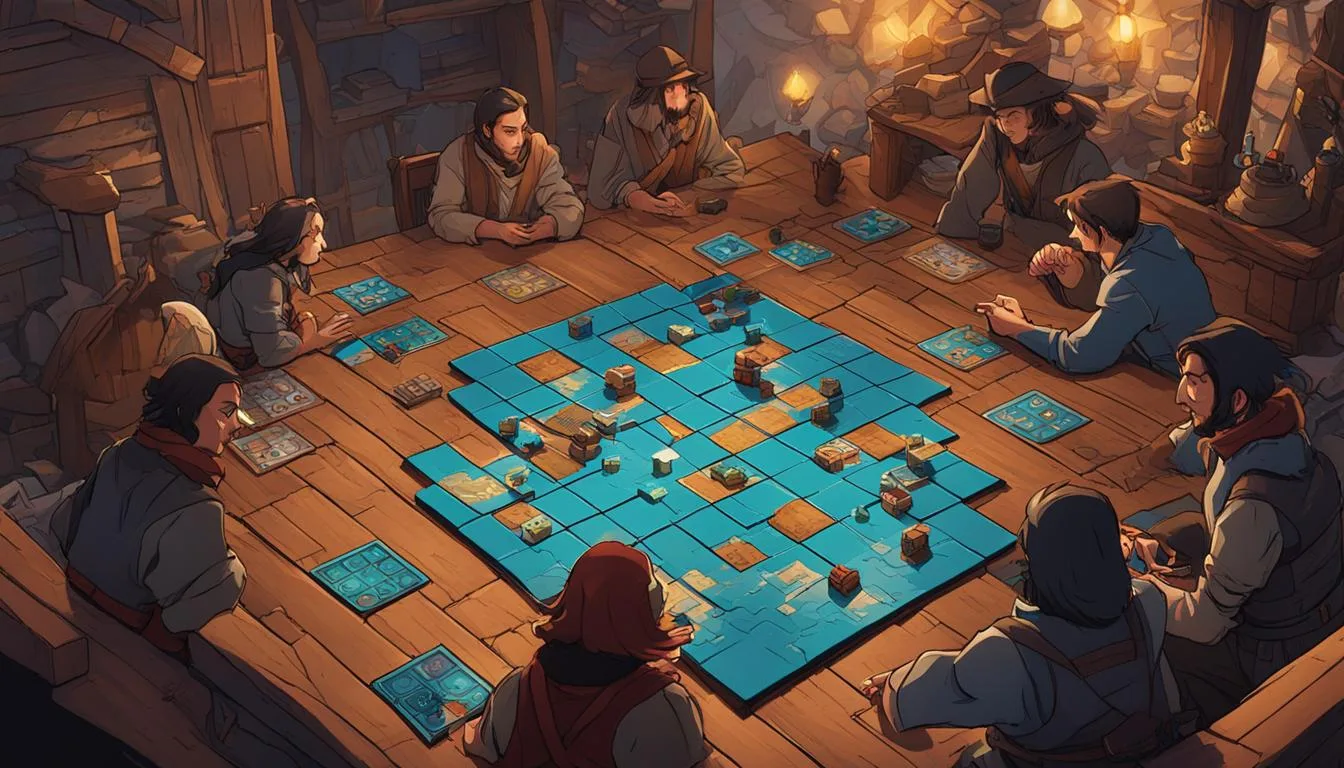
Terra Mystica puts you in control of one of 14 unique fantasy races, each competing to transform the landscape and build the most prosperous kingdom. This strategic masterpiece combines area control, resource management, and asymmetric player powers in ways that create fresh challenges every game.
Each faction feels completely different to play, from the desert-dwelling Nomads who excel at mobility to the mountain-loving Dwarves who focus on digging and construction. The game rewards both long-term planning and tactical adaptation as you compete for limited space on the hexagonal map.
TL;DR
- 14 asymmetric factions each offer completely different strategies and special abilities that change how you approach every game.
- Games last 6 rounds with each round offering 4 different bonus scoring opportunities that shift your tactical focus.
- Terraforming costs escalate from 1 spade for adjacent terrain types up to 3 spades for opposite terrain types.
- The cult track system provides 4 different paths to victory points through fire, water, earth, and air advancement.
Terra Mystica Faction Powers and Strategies
The heart of Terra Mystica lies in its faction diversity. Each race has unique buildings, special powers, and preferred terrain types that fundamentally change your approach to the game.
The Witches can transform terrain for free once per round, making them incredibly flexible in expansion. The Engineers generate power more efficiently and can upgrade their action spades, giving them terraforming advantages throughout the game.
Power-Focused Factions
Several factions excel at generating and using power effectively. The Chaos Magicians start with maximum favor tiles and can cycle power quickly, while the Giants have the largest power bowls and can afford expensive power actions more easily.
- Chaos Magicians – Start with favor tiles and excel at power cycling for consistent income.
- Giants – Large power capacity allows for frequent power actions and spade purchases.
- Engineers – Unique bridge building and spade upgrading creates terraforming efficiency.
- Swarmlings – Cheap buildings and unique upgrade paths focus on rapid expansion.
Terraforming and Expansion Mechanics
Terraforming transforms hexes from their natural state to your faction’s preferred terrain type. The cost depends on how different the terrains are, creating interesting decisions about where to expand next.
Adjacent terrain types cost one spade to transform, while opposite terrain types require three spades. This creates natural expansion paths and forces you to plan your territory development carefully.
Terrain Transformation Costs
- Adjacent terrain. Costs 1 spade and represents the most efficient expansion option.
- Two steps away. Costs 2 spades and requires more planning to justify the expense.
- Opposite terrain. Costs 3 spades and should only be done for critical strategic positions.
Smart terraforming creates connected networks of your terrain that enable building chains and maximize your income potential. Strategy board games like Terra Mystica reward this type of long-term territorial planning.
Building Development and Income
Your buildings generate coins, workers, priests, and power throughout the game. Upgrading buildings increases their output and unlocks new abilities, making development timing crucial for success.
Dwellings provide basic income and can upgrade to trading houses for more coins and power generation. Trading houses can then become temples for priest income and cult advancement, or strongholds for unique faction abilities.
Building Upgrade Priority
Upgrade to trading houses early for power generation, then focus on temples for cult advancement. Save stronghold construction for mid-game when you can maximize its special ability impact.
Building Types and Benefits
- Dwellings – Provide 1 worker per round and serve as the foundation for all other structures.
- Trading Houses – Generate 2 power and 2-4 coins depending on your faction’s abilities.
- Temples – Produce 1 priest per round and advance your position on cult tracks.
- Sanctuaries – Advanced temples that provide better cult advancement and priest generation.
- Strongholds – Unique faction buildings that unlock special abilities and provide significant benefits.
Cult Tracks and Scoring
The four cult tracks – fire, water, earth, and air – provide alternative scoring paths and ongoing benefits. Advancing on cult tracks requires priests or specific actions, and higher positions yield more victory points.
Each track offers immediate rewards for advancement plus end-game scoring based on your final position. Balancing cult advancement with building development creates interesting resource allocation decisions.
Cult Track Benefits
Moving up cult tracks provides immediate power or resource gains plus victory points at game end. The highest position on each track at the end of each round also scores bonus points.
- Fire Track – Provides power generation bonuses and terraforming cost reductions.
- Water Track – Offers shipping improvements and bridge-building advantages.
- Earth Track – Grants additional spades for terraforming and building bonuses.
- Air Track – Improves your position in turn order and provides power bonuses.
Round Bonuses and Tactical Adaptation
Each of the six rounds features different bonus tiles that reward specific actions like building, advancing on cult tracks, or connecting territories. These bonuses shift each game and require tactical flexibility.
Successful players adapt their strategies based on available bonuses while maintaining their long-term development plans. The tension between short-term bonus optimization and long-term strategy creates engaging decisions every round.
Common Bonus Categories
- Building bonuses. Reward constructing specific building types or quantities during the round.
- Cult bonuses. Provide extra points for advancing on specific cult tracks.
- Terrain bonuses. Give benefits for terraforming or controlling certain terrain types.
- Network bonuses. Reward connecting your territories or building in specific patterns.
Like other strategic transformation games, Terra Mystica rewards players who can balance multiple competing priorities while adapting to changing conditions.
Power Management System
The three-bowl power system creates a unique resource that flows between bowls as you use it. Power starts in bowl one, moves to bowl two when activated, and finally reaches bowl three where it becomes usable.
Managing your power cycle efficiently determines how often you can take power actions like gaining extra spades, coins, or workers. Factions with larger power capacity can take more power actions per round.
Power Actions and Timing
Power actions let you gain resources outside your normal income, but timing these actions correctly is crucial. Taking power actions too early might leave you short later, while waiting too long wastes opportunities.
- Spade purchases – Buy additional terraforming capacity for territorial expansion.
- Resource conversion – Transform power into coins, workers, or priests as needed.
- Cult advancement – Spend power to move up cult tracks when priests are limited.
- Special actions – Access unique power actions specific to your faction or game situation.
Frequently Asked Questions
How long does a typical Terra Mystica game take?
Most games run 90-150 minutes depending on player count and experience level. New players may need closer to 2 hours while experienced groups can finish in 90 minutes.
Which faction is best for beginners?
Engineers and Halflings are excellent starter factions because their abilities are straightforward and forgiving. Both factions have clear strategies and don’t require complex power management.
Can you win without focusing on cult tracks?
Cult tracks provide significant points and ongoing benefits, making them essential for competitive play. You need at least moderate cult advancement to remain viable in most games.
How important is turn order in Terra Mystica?
Turn order matters significantly for claiming bonus tiles and optimal building spots. The air cult track helps improve turn order, and going first in key rounds can be decisive.
What happens if multiple players want the same hex?
Only one player can terraform and build on each hex. Turn order determines who gets first choice, making timing and position selection crucial strategic elements.
Final Thoughts
Terra Mystica offers incredible depth through its asymmetric factions and multiple paths to victory, making each game feel like a completely different puzzle to solve. The interaction between terraforming, building development, and cult advancement creates meaningful decisions from the first turn to the last.
Start with simpler factions like Engineers or Halflings to learn the core systems, then explore the more complex races once you understand the game’s rhythm. You can purchase Terra Mystica from Z-Man Games or find detailed rules and strategy discussions on BoardGameGeek to deepen your understanding of this strategic masterpiece.

As the founder of Friends Game Night, Ryan channels his enthusiasm for gaming into a platform that celebrates the magic of gathering friends around the digital or physical tabletop. Through his website, Ryan shares insightful articles, reviews, and recommendations, aiming to inspire others to create their own memorable gaming moments.
Subscribe to Our Newsletter