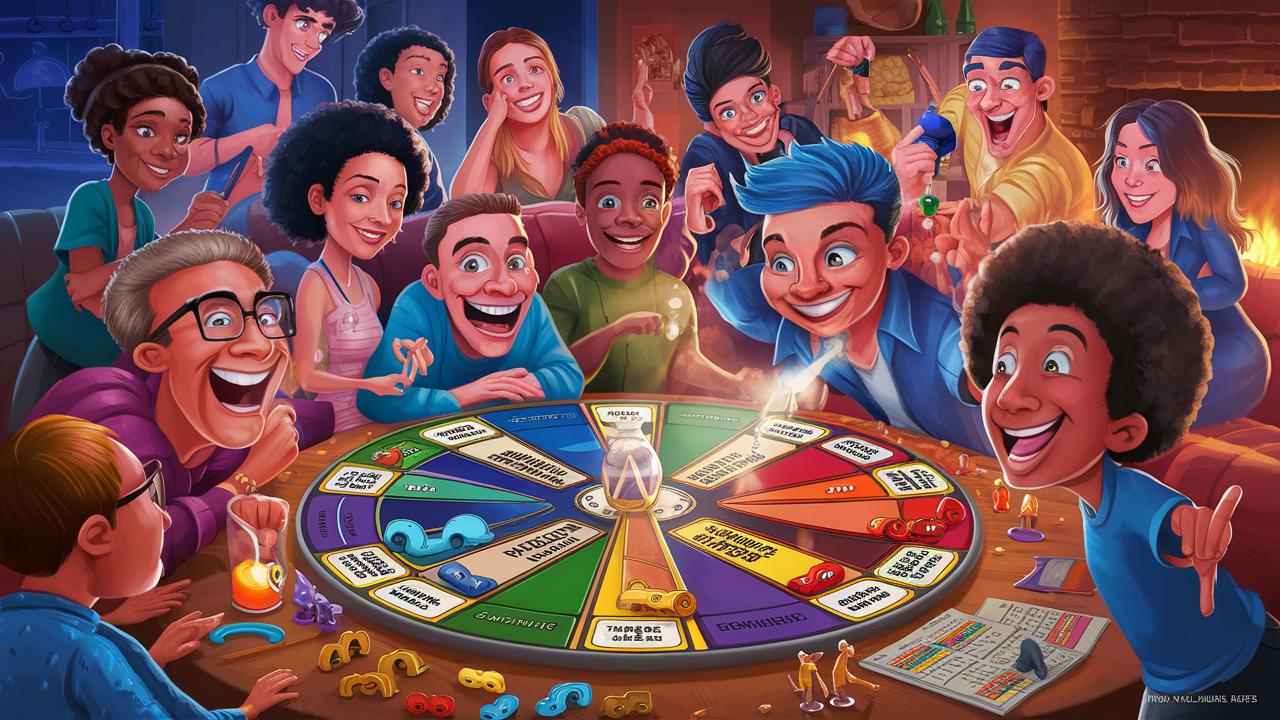
Trivial Pursuit Pursuing Knowledge And Winning Wedges combines learning with competitive fun in one of the most iconic board games ever created. This knowledge-based game challenges players to answer questions across six different categories while strategically moving around the board to collect colored wedges.
Since its debut in 1981, Trivial Pursuit has become a staple at family gatherings and game nights worldwide. The game tests your knowledge spanning decades of history, entertainment, science, and culture while keeping everyone engaged through its unique wedge-collecting mechanics.
TL;DR
- Players need to collect 6 colored wedges by answering questions correctly in category headquarters spaces.
- The standard game includes 2,400 questions across Geography, Entertainment, History, Arts & Literature, Science & Nature, and Sports & Leisure.
- Games typically last 60-90 minutes with 2-6 players ages 12 and up.
- Landing on other players’ spaces allows you to “bump” them back to the center hub space.
Trivial Pursuit Pursuing Knowledge And Winning Wedges
The core objective revolves around collecting one wedge from each of the six knowledge categories before heading to the center hub for a final question. Players roll a die to move their circular game piece around the board, with different colored spaces corresponding to different question categories.
Category headquarters appear as larger spoke-like spaces radiating from the center hub where players can earn wedges. These special spaces are the only locations where you can collect the colored pie pieces that fit into your game token.
Setting Up Your Trivial Pursuit Game
Each player chooses a colored playing piece that opens like a pie to hold six plastic wedges. Place all game pieces in the center hub space to start, and designate one player as the question reader for the first round.
The question cards contain six questions each – one for every category. Players take turns being the question reader, rotating clockwise after each player’s turn ends.
Understanding the Six Categories
Each category has a designated color that matches the wedges you collect and the spaces on the board. Knowing these categories helps you prepare mentally for the types of questions coming your way.
- Geography (Blue) – Countries, capitals, landmarks, and physical features of the world.
- Entertainment (Pink) – Movies, television, music, celebrities, and popular culture.
- History (Yellow) – Historical events, dates, figures, and significant moments in time.
- Arts & Literature (Brown) – Books, authors, paintings, sculptures, and creative works.
- Science & Nature (Green) – Biology, chemistry, physics, animals, and natural phenomena.
- Sports & Leisure (Orange) – Professional sports, games, hobbies, and recreational activities.
Basic Gameplay Mechanics
Players roll the die and move their piece the indicated number of spaces in any direction along the board’s spoke-and-wheel design. When you land on a colored space, the question reader draws a card and asks the question corresponding to that color.
Answer correctly and you continue rolling and moving until you answer incorrectly or choose to end your turn. Answer wrong and your turn ends immediately, passing play to the next player clockwise.
Collecting Wedges at Headquarters
The six category headquarters spaces are your targets for collecting wedges. These larger spaces sit at the ends of the board’s spokes, each colored to match their category.
Land on a headquarters space and answer the corresponding question correctly to earn that category’s wedge. Once you have a wedge for a category, you don’t need to return to that headquarters space unless you want to continue your turn by answering more questions.
Advanced Strategies for Success
Smart players develop routes around the board that maximize their chances of reaching headquarters spaces efficiently. Study the board layout to identify the shortest paths between different category headquarters.
Pay attention to other players’ strengths and weaknesses during the game. Some players excel at sports questions while struggling with arts and literature, which can inform your strategy when choosing directions to move.
The Roll Again Spaces
Special “Roll Again” spaces scattered around the board give you another turn when you land on them, regardless of whether you answer correctly. These spaces can be valuable for extending turns and reaching distant headquarters.
Use Roll Again spaces strategically by planning routes that incorporate them when you need to cover long distances on the board. The extra movement can make the difference between reaching a needed category headquarters and falling short.
Master the Center Hub Strategy
Once you collect all six wedges, position yourself near the center hub and wait for a favorable roll. You only get one chance at the final question, so timing your approach matters.
Winning the Game
After collecting wedges from all six categories, return to the center hub space where opponents choose your final question category from the six options. Answer this question correctly and you win the game immediately.
The final question adds tension since other players select the category, often choosing your perceived weakness. This mechanic keeps games competitive since leading players face a challenging final hurdle before claiming victory.
Popular Variations and House Rules
Many families develop house rules to speed up gameplay or add variety to their sessions. Some common modifications include allowing players to choose their own final question category or requiring two correct answers at the center hub.
Time limits for answers can prevent lengthy deliberation and keep games moving at a steady pace. Setting a 30-second limit per question maintains energy while still allowing players time to think through their responses.
Building Your Trivia Knowledge Base
Regular trivia night tips can improve your performance across all categories in Trivial Pursuit. Reading broadly across different subjects exposes you to the types of facts commonly featured in trivia questions.
Focus on gathering interesting facts from news, documentaries, and educational content rather than trying to memorize specific trivia. The game rewards general knowledge more than specialized expertise in narrow topics.
Category-Specific Preparation Tips
Entertainment questions often focus on major movies, hit songs, and famous celebrities from the past several decades. Stay current with popular culture while brushing up on classic films and music from earlier eras.
Geography questions frequently ask about national capitals, major rivers, mountain ranges, and country locations. A good world atlas or geography educational resources can help you review global landmarks and political boundaries.
Frequently Asked Questions
How long does a typical Trivial Pursuit game last?
Most games run 60-90 minutes depending on players’ knowledge levels and luck with dice rolls. Games can extend longer if players struggle with certain categories or take time deliberating answers.
Can you move backwards on the Trivial Pursuit board?
Yes, players can move in any direction along the board’s spoke-and-wheel paths including backwards toward the center hub. This flexibility allows strategic positioning to reach specific category headquarters.
What happens if you land on another player’s space?
Landing on an occupied space “bumps” the other player back to the center hub space. This mechanic adds a strategic element since you can set back opponents who are close to winning.
Do you need exact dice rolls to land on headquarters spaces?
No, you can land on any space with your exact roll count or stop short if desired. This rule prevents players from being stuck unable to reach headquarters due to bad dice rolls.
Can teams play Trivial Pursuit together?
Yes, team play works well especially with larger groups or when knowledge levels vary significantly. Teams can discuss answers before giving their final response to the question reader.
Final Thoughts
Trivial Pursuit Pursuing Knowledge And Winning Wedges remains a fantastic choice for family board games that combine education with entertainment. The game rewards broad knowledge while providing opportunities for players to learn new facts during every session.
Whether you’re hosting a casual family game night or organizing more competitive trivia party games, this classic offers engaging gameplay that brings people together around shared learning and friendly competition.
class=”aligncenter size-large wp-image-1684″ title=”Trivial Pursuit reviews”
class=”aligncenter size-large wp-image-1685″ title=”Trivial Pursuit social game”

As the founder of Friends Game Night, Ryan channels his enthusiasm for gaming into a platform that celebrates the magic of gathering friends around the digital or physical tabletop. Through his website, Ryan shares insightful articles, reviews, and recommendations, aiming to inspire others to create their own memorable gaming moments.
Subscribe to Our Newsletter