
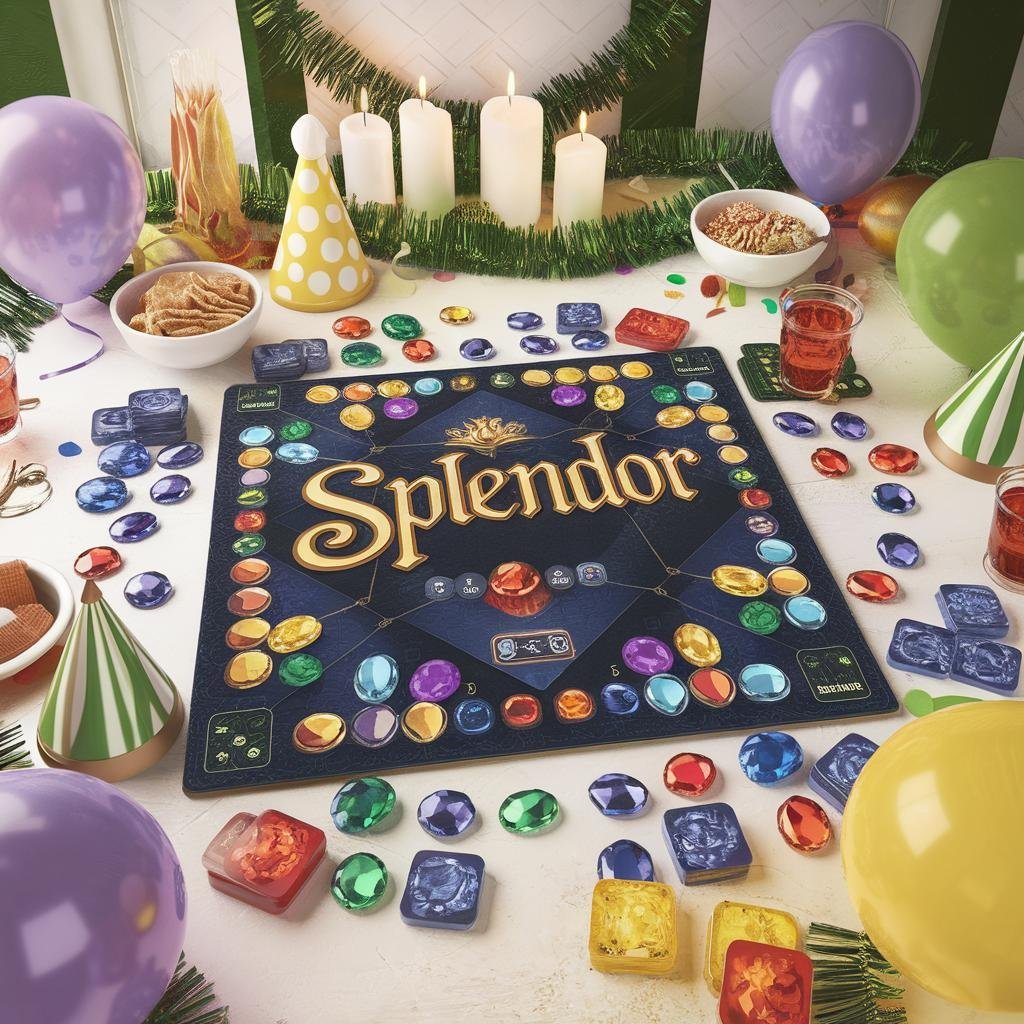
Splendor Board Game Gem Trading Excellence combines strategic resource management with elegant gameplay that keeps players engaged from start to finish. This Renaissance-themed engine-building game challenges you to collect gems, purchase development cards, and attract noble patrons in your quest to become the most prestigious merchant.
The beauty of Splendor lies in its simple rules that create deep strategic decisions. Every choice matters as you balance immediate gains against long-term engine building.
TL;DR
- Games typically last 30 minutes with 2-4 players competing to reach 15 prestige points first.
- Development cards provide permanent gem bonuses that reduce costs for future purchases by up to 7 gems per card.
- Noble tiles award 3 prestige points each when you meet their specific gem requirements automatically.
- The most expensive Tier 3 cards offer 4-5 prestige points but require 12-20 total gems to purchase.
Splendor Board Game Gem Trading Excellence
Splendor transforms gem trading into an addictive puzzle where every decision shapes your economic empire. Players start with nothing and must carefully collect colored gems to purchase development cards that provide permanent bonuses and prestige points.
The game’s three-tier card system creates natural progression from cheap Ruby and Sapphire cards to expensive Diamond and Emerald powerhouses. Your early purchases fuel later acquisitions in a satisfying engine-building loop.
Core Gameplay Mechanics
Each turn offers four possible actions that determine your path to victory. The key is recognizing when to pivot between gem collection and card purchases.
- Take 3 different gems – The most common early-game action for building purchasing power.
- Take 2 gems of the same color – Only available when 4+ gems of that color remain in the supply.
- Purchase a development card – Spend gems to gain permanent bonuses and prestige points.
- Reserve a card – Hold a card for later purchase and gain a wild gold gem.
The gem limit of 10 tokens forces tough decisions about which resources to prioritize. Smart players cycle through gems efficiently rather than hoarding them.
Development Card Strategy
Development cards form the heart of your strategy since they provide both immediate prestige points and permanent gem bonuses. Tier 1 cards cost 2-4 gems but only give 0-1 prestige point, while Tier 3 cards demand massive investments for 3-5 points.
The permanent bonuses matter more than most new players realize. A Diamond bonus card lets you purchase future Diamond-heavy cards without spending actual Diamond gems from your hand.
Noble Patron Tactics
Noble tiles add an automatic scoring element that rewards balanced development card collections. Each noble requires specific combinations like 4 red gems, 4 black gems, or 3 blue gems and 3 green gems worth of permanent bonuses.
Unlike deck building games that require careful hand management, nobles visit you automatically when you meet their requirements. This creates exciting moments where a single card purchase triggers multiple nobles competing for your attention.
Focus on nobles that align with your current development path rather than forcing awkward purchases. The 3 prestige points per noble can easily determine the winner in close games.
Advanced Reservation Techniques
Reserving cards serves multiple purposes beyond just holding valuable cards for later. The gold gem you receive acts as a wild resource that can substitute for any color when making purchases.
Reserve expensive Tier 3 cards early to deny opponents while building toward their requirements. You can also reserve cheaper cards to block opponents from completing noble requirements or engine combinations.
Master the Gem Economy
Never take gems without a specific purchase plan in mind. Efficient players cycle through 6-8 gems per turn cycle rather than accumulating large hoards.
Winning Strategies and Timing
Victory in Splendor comes from recognizing when to shift from engine building to point accumulation. Most games end between turns 15-20, so timing your final push matters enormously.
Early game focuses on cheap Tier 1 cards that provide engine bonuses with minimal prestige points. Mid-game transitions to selective Tier 2 purchases that balance points with bonuses. Late game emphasizes high-value Tier 3 cards and noble collection.
- Establish your engine. Purchase 3-4 Tier 1 cards focusing on 2-3 gem colors for consistency.
- Build momentum. Target Tier 2 cards that provide 2-3 prestige points while maintaining bonus diversity.
- Sprint to victory. Reserve and purchase high-value Tier 3 cards while completing noble requirements.
Watch for opponents approaching 12-13 prestige points and adjust your strategy accordingly. Sometimes blocking a key purchase matters more than advancing your own position.
Player Count Considerations
Splendor scales well across player counts but requires different tactical approaches. Two-player games feature more predictable gem availability and longer-term planning, while four-player games create resource scarcity and tactical blocking opportunities.
In larger games, reservation becomes critical for securing key cards before opponents can interfere. The faster pace also favors flexible strategies over rigid long-term planning.
Solo variants and digital implementations let you practice against AI opponents, though nothing replaces the psychological elements of reading human opponents. Like pure strategy games, Splendor rewards players who can adapt their plans based on opponent actions.
Frequently Asked Questions
How long does a typical Splendor game last?
Most games finish in 30 minutes with experienced players, though first games may take 45 minutes while learning the card combinations.
Can you take gems if you already have 10 tokens?
No, you must discard down to 10 tokens before your turn ends, so taking gems when at the limit wastes actions.
What happens when multiple nobles visit you simultaneously?
You choose which noble to take and return the others to the table for other players to potentially claim later.
Is Splendor suitable for families with younger children?
Children aged 10+ can learn Splendor easily, though younger kids may struggle with the mathematical calculations and forward planning required.
How important is card reservation in competitive play?
Reservation becomes essential in 3-4 player games for blocking opponents and securing key cards, while 2-player games rely less on this mechanic.
Final Thoughts
Splendor Board Game Gem Trading Excellence offers the perfect balance of accessibility and depth that makes it a modern classic. The satisfying progression from struggling to afford basic cards to purchasing expensive developments creates a compelling arc in every game.
Start with gem collection and engine building, then transition to point accumulation as you approach the 15-point victory threshold. Master these fundamentals and you’ll discover why Splendor remains a favorite among both casual players and serious strategists.

As the founder of Friends Game Night, Ryan channels his enthusiasm for gaming into a platform that celebrates the magic of gathering friends around the digital or physical tabletop. Through his website, Ryan shares insightful articles, reviews, and recommendations, aiming to inspire others to create their own memorable gaming moments.
Subscribe to Our Newsletter


